Updated Nov. 23, 2026. Surveys use different questions, samples and dates, so compare figures within a survey rather than across them.
Three years after ChatGPT arrived, the surveys agree on one thing: using AI is now an ordinary part of college work for most students, faculty and staff. They also agree on the problem. Institutions' policies, training and strategy have not kept pace with how people actually use the tools.
Students: weekly use is the norm
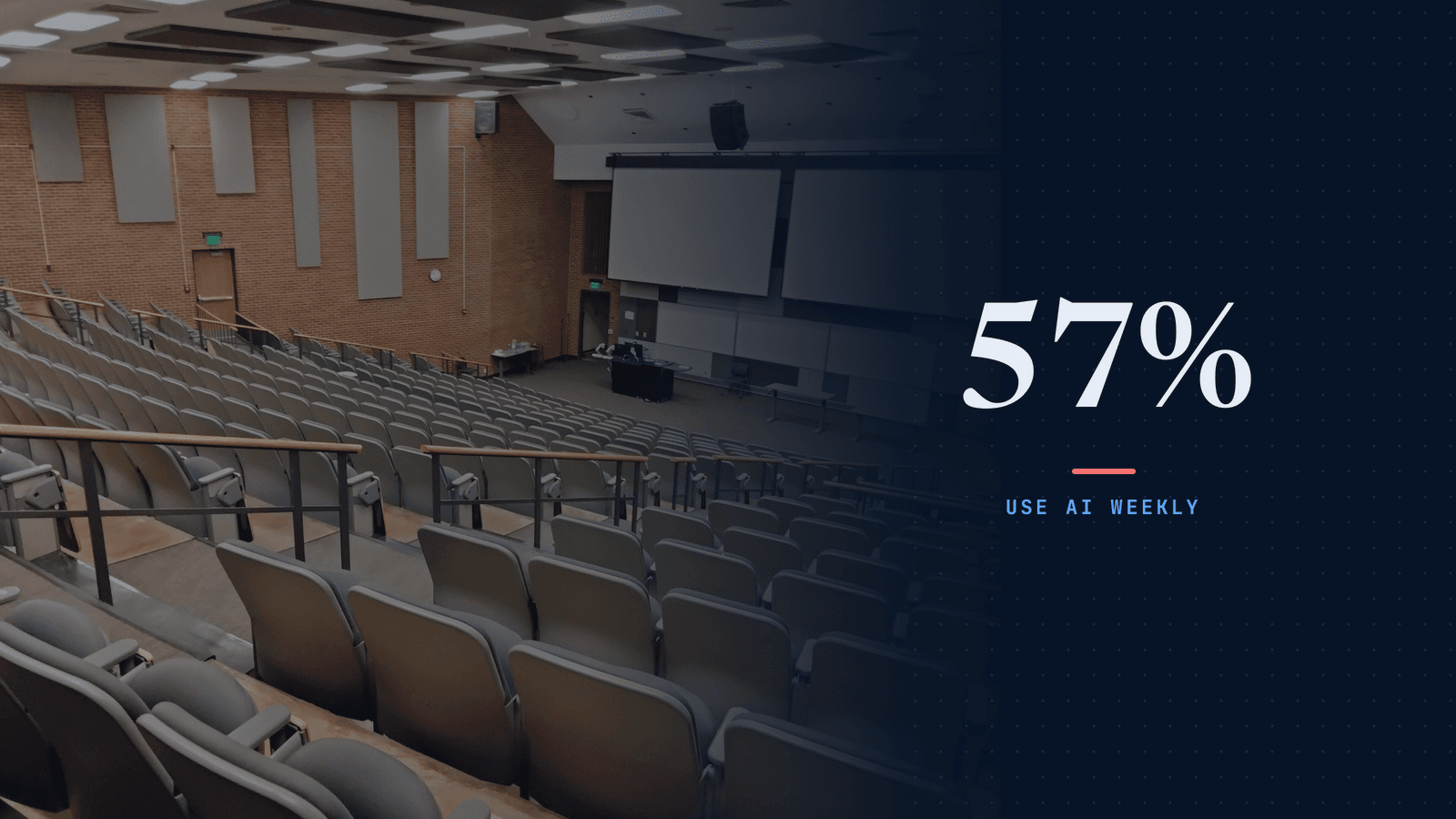
- 57% of U.S. college students use AI in their coursework at least weekly, and about one in five use it daily, according to the Lumina Foundation-Gallup 2026 State of Higher Education study, conducted in October 2025 (Gallup).
- Their most common uses, daily or weekly: getting help with coursework they don't understand (64%), checking answers (60%), editing writing (54%) and summarizing lectures or notes (54%). Fewer use it to write papers (36%) (Gallup).
- Yet 42% say their school discourages AI use and 11% say it prohibits it. Only 7% say students are encouraged to use it freely, and 35% say it's encouraged with limits (Gallup).
- In Inside Higher Ed's October 2026 Student Voice survey of 5,034 students at 310 institutions, 20% said they don't use generative or agentic AI for college work. A quarter (25%) said they've changed how they write to avoid being falsely flagged by AI detectors, and 16% said they rely on AI too heavily to think or write on their own (Inside Higher Ed).
How fast this changed: in EDUCAUSE's 2025 Students and Technology Report, based on a fall 2024 survey of nearly 40,000 undergraduates at more than 160 institutions, 43% of students said they had not used generative AI in their courses at all. Only 51% had received guidance on AI use, and 52% said most of their instructors prohibited it (Poets&Quants; eCampus News). EDUCAUSE's 2026 student report is available to members only.
Faculty and staff: near-universal use, uneven rules
Daily generative AI use in U.S. higher education, spring 2026
- Administrators43%
- Students32%
- Faculty25%
- For the first time, more than half of administrators, faculty and students use AI at least weekly, Tyton Partners found in its Time for Class 2026 survey of more than 3,000 people at over 750 U.S. colleges, fielded in April and May 2026. Daily use reached 43% of administrators, 32% of students and 25% of faculty (Tyton Partners).
- In EDUCAUSE's survey on AI at work, run with AIR, NACUBO and CUPA-HR (1,960 respondents, fall 2025), 94% of higher-ed staff and faculty said they had used AI tools for work in the past six months, and 73% of recent users do so daily or weekly (AIR).
- 56% of those respondents have used AI tools for work that their institution doesn't provide, and only 11% are required to use AI at work (AIR).
- Roughly seven in 10 provosts use AI in their own work at least weekly, according to Inside Higher Ed's 2026 survey of 376 chief academic officers (Inside Higher Ed).
The policy gap
Higher-ed staff and faculty: AI use vs. policy awareness
- Used AI for work in past six months94%
- Use it daily or weekly (recent users)73%
- Used tools the institution doesn’t provide56%
- Aware of institutional AI policies54%
- Institution measures AI return on investment13%
- Only 54% of higher-ed staff and faculty are aware of policies and guidelines for using AI at work, even though 94% use it (AIR).
- Just 32% of administrators report an institution-wide AI policy. Where one exists, only 22% of faculty believe it's effective, compared with 44% of administrators (Tyton Partners).
- Only about one in 10 provosts say their institution has a centralized AI strategy (Inside Higher Ed).
- Just 13% of respondents said their institution is measuring the return on investment of work-related AI tools (AIR).
- 80% of respondents said their institution encourages faculty and staff to build AI skills on their own, and 71% said it offers in-house professional learning (EdTech Magazine).
What seems to work: only 13% of faculty at institutions that ban AI entirely say their policy is effective, compared with 30% where AI is built into assignments. Faculty who redesign assessments around AI, 24% of faculty, report a statistically significant advantage of more than 10 percentage points on attendance challenges (Tyton Partners).
K-12 teachers: training is growing, slowly
The share of K-12 teachers who say they've had no training on using generative AI in the classroom fell from almost 60% in October 2024 to 50% in fall 2025 and 42% in winter 2026, according to the EdWeek Research Center. In the latest survey, 22% reported multiple training sessions and 9% ongoing training (Education Week).
Outside the U.S.
In the Digital Education Council's 2026 survey of Latin American higher education, 92% of students said they use AI, up from 86% in the council's 2024 global survey, and 67% use it daily or weekly. But 65% worry that AI may make learning too shallow and discourage critical thinking and creativity (Digital Education Council).
Sources
- AI Is Routine for College Students, Despite Campus Limits. Gallup (2026)
- Time for Class 2026: The AI Tipping Point: From Monitoring Students to Engaging Them. Tyton Partners (2026)
- AI at Work in Higher Education: What Practitioners Are Doing, What They’re Worried About, and What It Means for Institutional Readiness. AIR (Association for Institutional Research) (2026)
- AI is Reshaping Higher Ed Workplaces. EdTech Magazine (2026)
- AI Changing College; Old Challenges Persist. Inside Higher Ed (2026)
- From AI Use to Funding Cuts: How Provosts Navigate 2026. Inside Higher Ed (2026)
- Students Demand More Than Just Wi-Fi: Report Highlights Gaps In Tech Integration & Career Readiness. Poets&Quants for Undergrads (2025)
- 6 things to know about the student experience today. eCampus News (2026)
- More Schools Are Providing AI Training for Teachers. Is It Any Good?. Education Week (2026)
- AI Adoption Is Nearly Universal Among Students, But Confidence Is Not. Digital Education Council (2026)
- Cover photo: Ohio University Lecture Hall (Garden Sprite, CC0, modified). Wikimedia Commons (2024)