Skip to content
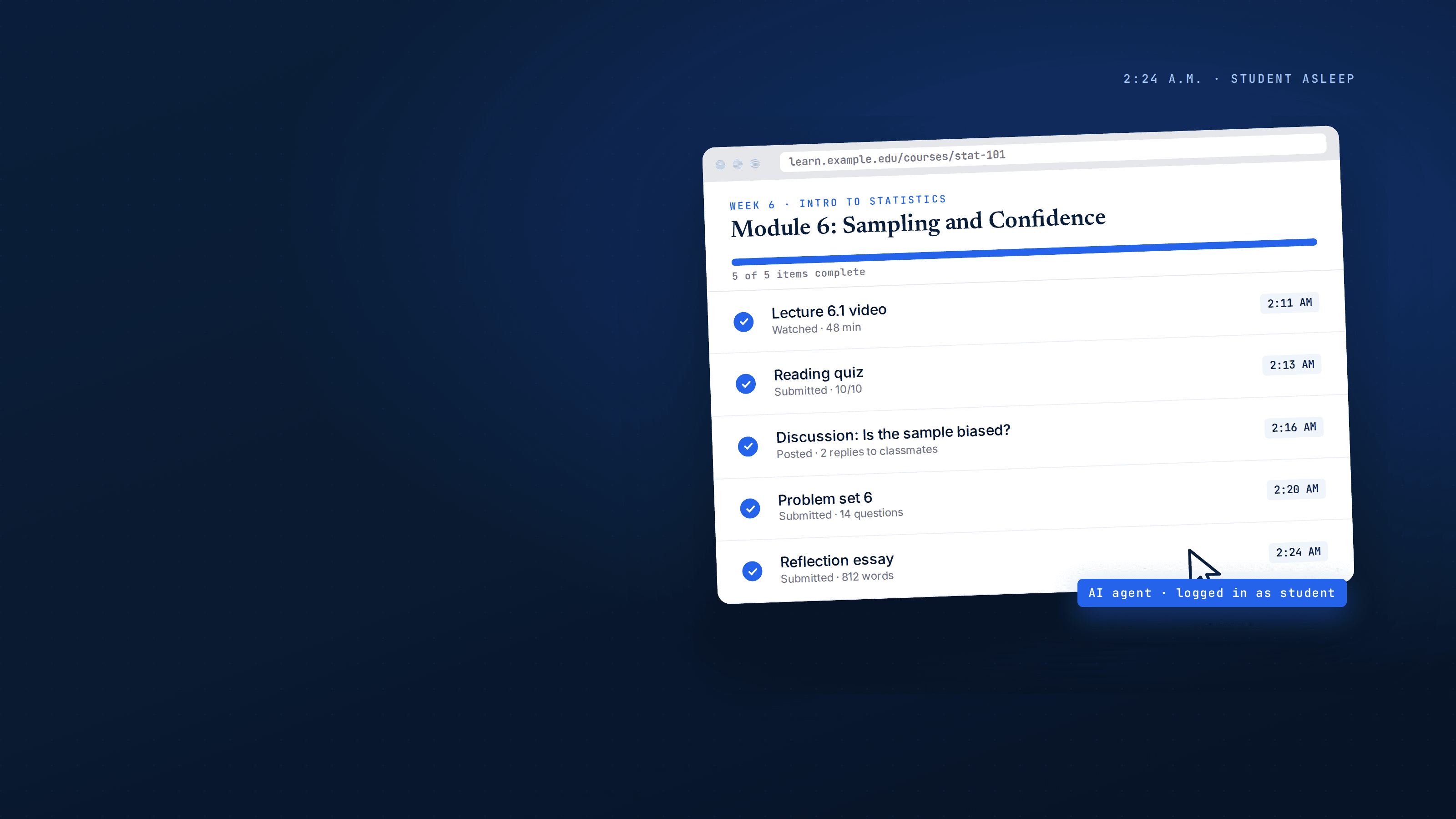
Illustration: an online course page in which every lecture, quiz, discussion post and essay is marked complete between 2:11 and 2:24 a.m., with a cursor labeled “AI agent, logged in as student.”

Tech

The Robot Took the Class: AI Agents Are Now Finishing Entire Online Courses 

Tools that log in as students can watch lectures, post in discussions and submit the work. Learning platforms say there is no fail-safe way to stop them. Is online schoolwork optional now?

By EdTech Current Editorial Team5 MIN READ

An illustration of how an AI agent can work through an online course on a student’s behalf.

Illustration: EdTech Current

Education Department Finalizes Accreditation Overhaul, Effective July 2027

By EdTech Current Editorial Team

The AIM rule opens the door to new accreditors, makes switching easier, ties quality to student outcomes and cost, and writes transfer-credit due process into federal rules.

The U.S. Department of Education published its final Accreditation, Innovation, and Modernization rule in the Federal Register on Oct. 30, a day after announcing it. The rule, known as AIM, takes effect July 1, 2027 . It changes how the federal government recognizes the agencies that accredit colleges, and through them, which institutions can draw on more than $100 billion a year in federal student aid. The rule makes it easier to start a new accreditor and to switch between accreditors. It requires accreditors to weigh student outcomes against what college costs, sets due-process rules for undergraduate transfer credit, and bars accreditors from enforcing what the department calls "illegal DEI" requirements. Under Secretary Nicholas Kent said the rule creates "a more competitive and transparent accreditation system" and that "accreditors have effectively served as a cartel to protect their interests," Higher Ed Dive reported . The department made no substantive changes from its August proposal, according to the Association of Governing Boards , despite roughly 7,000 public comments and opposition from…

Continue reading →
AI in Education

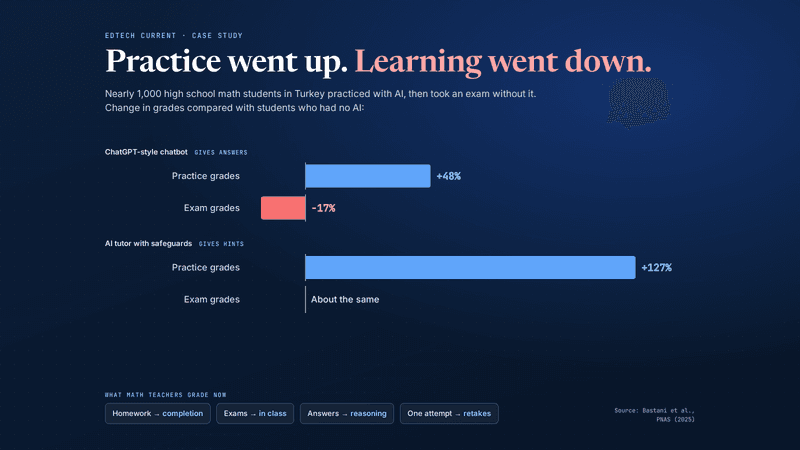
What Are Math Teachers Grading Now That AI Can Do the Homework?

AI can solve most homework problems, so a correct answer no longer shows who learned the math. Here is how a Berkeley mathematician, a California high school teacher, a math educator’s 80/20 policy and Columbia’s math department are changing what they grade.

By EdTech Current Editorial Team

Data & Facts

Best Edtech Tools for Teachers in 2026

Teachers still do most of their work in Google Classroom, Canvas and a few quiz games, and ChatGPT, Gemini and MagicSchool lead AI use. We compared the tools on cost, evidence, privacy ratings and accessibility.

AI tools used by math and science teachers who use AI

Spring 2026

  • ChatGPT87%
  • Gemini44%
  • MagicSchool40%
  • Microsoft Copilot14%
  • SchoolAI11%
  • Brisk10%
  • Claude7%
  • Khanmigo5%
ChatGPT is near-universal. Gemini’s share doubled from 22% a year earlier, the only significant change.Source: AmplifyGAIN Center, RAND American Teacher Panel, 2026
Read the story →

Videos & Podcasts

Watch →
Archive →

Cornell’s Chi Phi Case: What We Know So Far

The Chi Phi case is now in the hands of New York’s attorney general and a trustee-appointed review led by Sally Yates, and Cornell has suspended fraternity parties for the year. Here is the timeline.

EdTech Current Editorial Team2 min

Compliance watch

Deadlines that shape buying decisions

Compliance hub
  1. 170days

    Title II compliance: population 50,000+

    April 26, 2027 · ADA Title II

  2. 185days

    HHS Section 504 web compliance: 15+ employees

    May 11, 2027 · Section 504 (HHS rule)

  3. 328days

    Annual Security Report due

    October 1, 2027 · Clery Act

The weekly briefing

Edtech intelligence, every week.

Get weekly edtech intelligence on AI, products, research, compliance, and market shifts.

Free · One email a week · Unsubscribe anytime