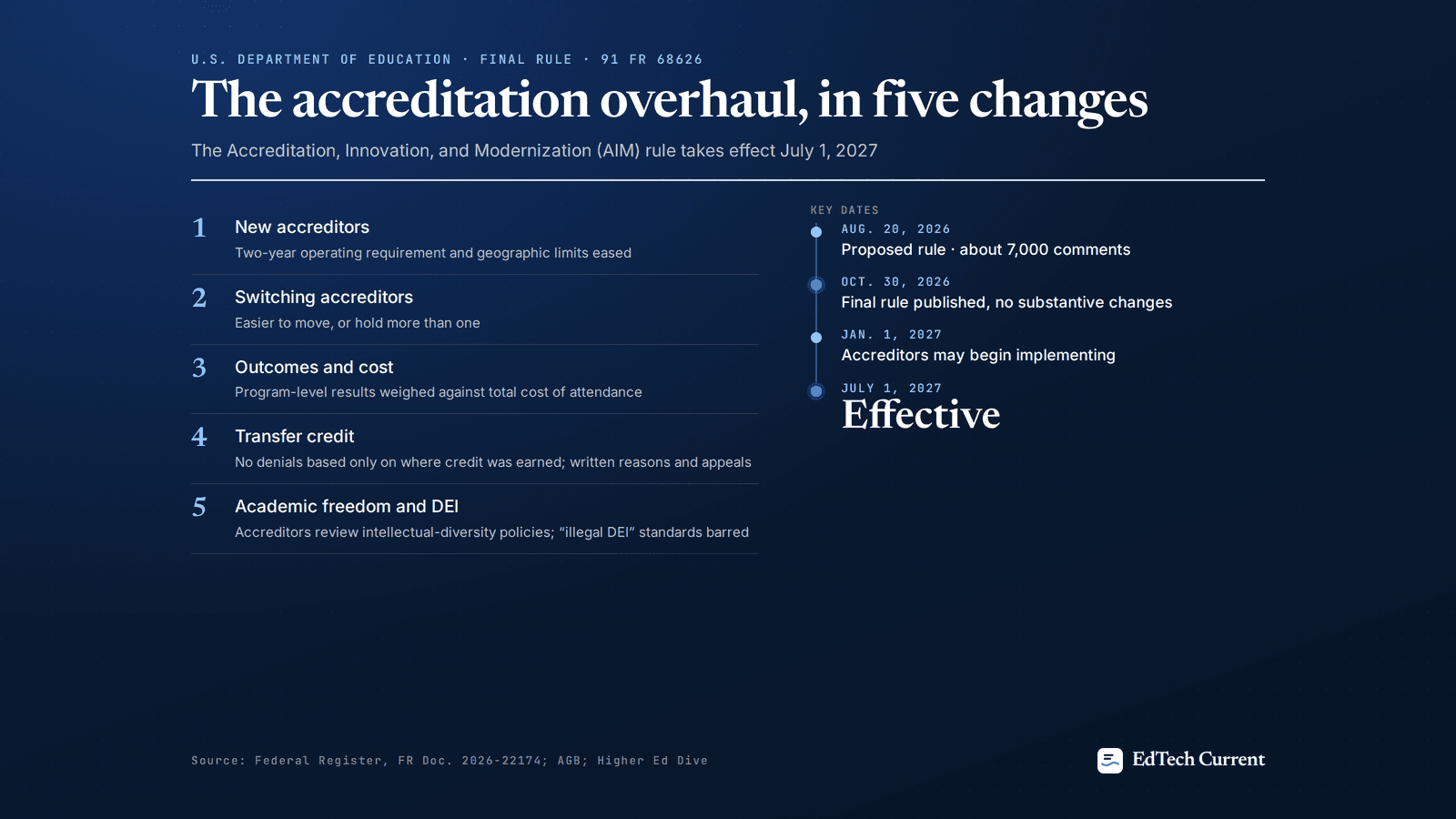
The U.S. Department of Education published its final Accreditation, Innovation, and Modernization rule in the Federal Register on Oct. 30, a day after announcing it. The rule, known as AIM, takes effect July 1, 2027. It changes how the federal government recognizes the agencies that accredit colleges, and through them, which institutions can draw on more than $100 billion a year in federal student aid.
The rule makes it easier to start a new accreditor and to switch between accreditors. It requires accreditors to weigh student outcomes against what college costs, sets due-process rules for undergraduate transfer credit, and bars accreditors from enforcing what the department calls "illegal DEI" requirements.
Under Secretary Nicholas Kent said the rule creates "a more competitive and transparent accreditation system" and that "accreditors have effectively served as a cartel to protect their interests," Higher Ed Dive reported.
The department made no substantive changes from its August proposal, according to the Association of Governing Boards, despite roughly 7,000 public comments and opposition from 23 state attorneys general.
What the rule changes
- New accreditors. The rule drops the requirement that a new accreditor operate for two years before seeking federal recognition, and removes geographic limits, AGB reports. Under the final rule, a new agency can qualify with established standards and procedures and at least one application for accreditation, according to Higher Ed Dive.
- Switching accreditors. Colleges will find it easier to move to a different accreditor or hold more than one, partly through common forms, CollegeAid Services reports.
- Student outcomes and cost. Accreditors must review student achievement at the institution and program level, using "measures appropriate to institutional missions" such as completion, licensure and employment, and must weigh economic return relative to the total cost of attendance (AGB; CollegeAid Services).
- Transfer credit. Colleges may not deny undergraduate transfer credit solely because of where it was earned or who accredited that institution. They must apply published policies consistently, tell students in advance how many credits will count, give written reasons for denials and offer an appeal (AGB). The department cites a 2017 Government Accountability Office finding that transfer students lost about 43% of their credits.
- Academic freedom and DEI. Accreditors must consider whether colleges protect academic freedom and intellectual diversity, and may not enforce "illegal diversity, equity, and inclusion requirements" (Higher Ed Dive).
The rule also limits accreditor review of how state-created public institutions appoint boards and leaders, separates accreditors from affiliated trade associations, and expands teach-out and transcript protections for students at closing colleges (AGB).
The AIM rule, step by step
Executive order on accreditation
Executive Order 14279, “Reforming Accreditation to Strengthen Higher Education,” directs the department to overhaul recognition rules.
Negotiators reach consensus
The AIM negotiated-rulemaking committee agrees on draft regulations.
AACOM ↗Proposed rule published
Comments run for one month and total about 7,000. Twenty-three state attorneys general file in opposition.
Federal Register ↗Latest
Final rule published
91 FR 68626, with no substantive changes from the proposal.
Federal Register ↗Accreditors may begin implementing
They cannot impose new requirements on institutions yet.
AGB ↗Rule takes effect
How fast it moved
The rule traces to President Trump's April 2025 executive order on accreditation, Executive Order 14279. A negotiated-rulemaking committee reached consensus in May 2026, AACOM reported. The department published its proposed rule on Aug. 20 and took comments for one month, the legal minimum. A coalition of 23 state attorneys general filed comments opposing it on Sept. 21, Duane Morris noted.
Five weeks later, the final rule appeared with technical corrections and clarifications only. The department rejected requests to phase it in. Publishing before Nov. 1 meant the rule could take effect on July 1, 2027, under the Higher Education Act's master calendar.
Accreditors may begin carrying out the changes on Jan. 1, 2027, but "cannot impose resulting new requirements on institutions or programs before July 1, 2027," AGB says. The department says "the eight months between November 2026 and July 2027 is sufficient time" for accreditors to rewrite their standards, Community College Daily reported.
One new agency stands to benefit quickly. The Commission for Public Higher Education, created by Southern public university systems in 2025, completed its first site visit at Florida Polytechnic University in August. It expects to apply for federal recognition in November 2026 and to be eligible by mid-July 2027, Florida Poly said.
What accreditors and colleges said
The Council for Higher Education Accreditation, which represents accreditors, was critical. "Many of the central concerns raised by CHEA and the higher education community remain largely unresolved," CHEA President Nasser Paydar said Oct. 29, adding that "some of the provisions impose new requirements on accrediting organizations and institutions" (Higher Ed Dive). In its September comments, CHEA defended accreditation as an "independent, peer-based system of quality assurance."
David Baime of the American Association of Community Colleges called the final rule "virtually a carbon copy" of the proposal, Community College Daily reported. AACC still expects colleges to accept more transfer credit, and said the department's narrow reading of the cost-benefit requirement helps community colleges "if implemented that way."
As of Oct. 31, the American Council on Education, the Association of Public and Land-grant Universities and the largest regional accreditors had not issued statements on the final rule. No lawsuit had been filed.
What it means for campuses
From July 2027, accreditation, institutional research and registrar offices should expect accreditors to ask for:
- program-level outcomes, such as completion, licensure and employment;
- cost and economic-return evidence, including any cost-benefit analysis the institution has done;
- a transfer-credit process with published criteria, advance notice of credits accepted, written reasons for denials and an appeal;
- documented academic-freedom and intellectual-diversity policies.
The rule does not appear to prescribe specific data elements or thresholds. Each accreditor will set those in its revised standards over the coming months.
Sources
- Accreditation, Innovation, and Modernization (final rule), 91 FR 68626. Federal Register (2026)
- Final accreditation rule sets the stage for system overhaul. Higher Ed Dive (2026)
- Policy alert: Department of Education finalizes accreditation rule. AGB (2026)
- Washington Watch: Final accreditation rule lands. Community College Daily (2026)
- ED finalizes accreditation reforms with July 2027 effective date. CollegeAid Services (2026)
- Comment on the AIM proposed regulations. CHEA (2026)