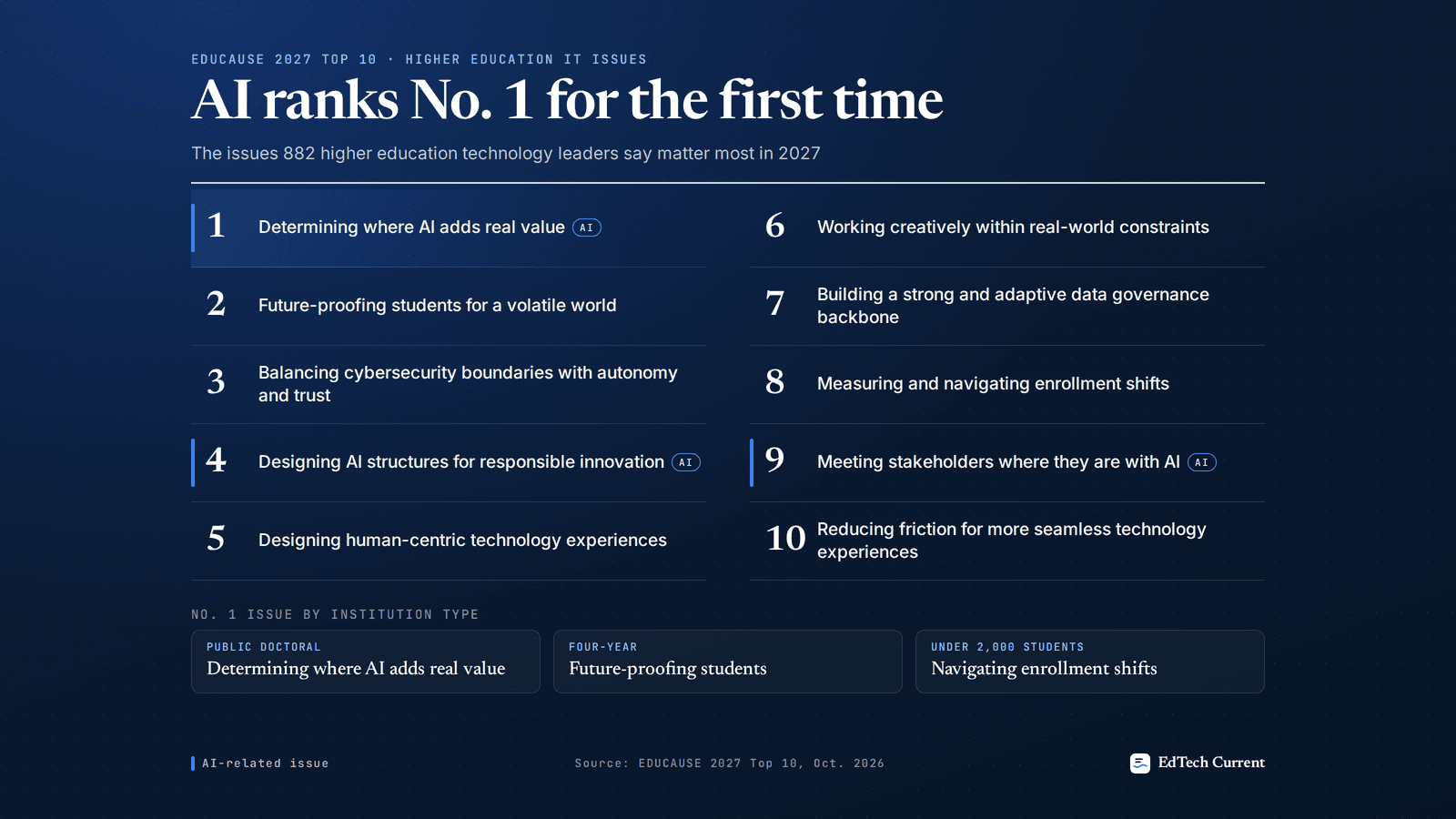
For years, cybersecurity was the issue most likely to sit at the top of EDUCAUSE’s annual list of higher education’s technology priorities. For 2027, an AI issue holds the No. 1 spot for the first time: “Determining where AI adds real value.”
EDUCAUSE unveiled the 2027 Top 10 at its annual conference in Denver, which ran Sept. 28 to Oct. 2. The list is built from interviews with senior higher education leaders and a survey of the wider community; 882 people voted, the largest pool to date, GovTech reported.
“This doesn’t signal consensus as much as it signals urgency,” said Mark McCormack, EDUCAUSE’s senior director of research and insights. He called the moment “the age of perpetual change,” Inside Higher Ed reported.
The 2027 EDUCAUSE Top 10
Rank | Issue | What institutions are doing |
|---|---|---|
1 | Determining where AI adds real value | Building rubrics to evaluate AI tools before buying, checking fit with institutional values and whether a tool adds something new |
2 | Future-proofing students for a volatile world | Adding in-demand technology skills and experiential learning; rethinking assessment to build critical thinking |
3 | Balancing cybersecurity boundaries with autonomy and trust | Collaboration, better security training, and trust between IT and other departments |
4 | Designing AI structures for responsible innovation | AI steering committees, department feedback, and policies that aren’t overly restrictive |
5 | Designing human-centric technology experiences | Digital accessibility compliance, driven by the ADA Title II deadline in April 2027; consolidating services |
6 | Working creatively within real-world constraints | New ways to operate with limited resources, including AI and automation |
7 | Building a strong and adaptive data governance backbone | Institution-wide data standards, especially for historically siloed data |
8 | Measuring and navigating enrollment shifts | Stronger data and analytics to track enrollment gains and losses ahead of the demographic cliff |
9 | Meeting stakeholders where they are with AI | Listening to each campus area as AI is adopted; targeted faculty training |
10 | Reducing friction for more seamless technology experiences | Requiring vendor interoperability, eliminating duplicate tools, new ERP systems |
Descriptions summarize GovTech’s conference coverage. EDUCAUSE’s full report has the detail.
What changed: from experimenting to proving value
Two of the top four issues, and three of the ten, are about AI. But the No. 1 item isn’t about adopting AI. It’s about judging it. EDUCAUSE frames the shift as moving from experimentation to “thoughtful evaluation of, and investment in” uses that serve an institution’s mission.
In practice, that means institutions are writing evaluation rubrics before they buy, asking what a tool does that existing systems don’t, and deciding which pilots to end. It also explains No. 4: the governance needed to say yes or no consistently. SUNY’s new systemwide AI policy, which requires every campus to publish an AI policy covering oversight and procurement safeguards by Dec. 31, 2026, is one example, according to EdTech Magazine.
Cybersecurity didn’t disappear. It moved to No. 3, reframed around trust and shared responsibility rather than controls alone. “Our people are our first line of defense,” said Josh Callahan, chief information security officer at California State University. On the 2026 list, released a year ago, a collaborative cybersecurity item was listed first, Campus Technology reported.
Accessibility is on the list, with a deadline attached
No. 5, “designing human-centric technology experiences,” is driven in large part by digital accessibility compliance and the ADA Title II deadline of April 26, 2027 for most public institutions. For what the rule requires, its exceptions and a step-by-step plan, see our complete guide to federal digital accessibility rules.
Priorities differ by institution
EDUCAUSE’s “What About Your Institution?” view shows the order changes by segment, according to GovTech:
- Public doctoral institutions: determining where AI adds real value is No. 1.
- Four-year institutions: future-proofing students is No. 1.
- Institutions with fewer than 2,000 students: measuring and navigating enrollment shifts is No. 1.
- Large institutions: enrollment shifts doesn’t make the top 10.
For small colleges, the enrollment pressure is concrete: Northwestern Michigan College’s president noted that Michigan’s 28 public community colleges competed for about 16,000 high school graduates last year.
What it means for technology leaders
- Write an AI value rubric before the next purchase. Define what evidence a tool must show (learning outcomes, time saved, cost avoided) and who decides.
- Retire as well as add. Several issues (6 and 10) reward consolidation: fewer overlapping tools, better integration, lower cost.
- Treat accessibility and data governance as infrastructure. Both are now compliance and strategy questions, not projects.
- Use the segment view. The national ranking is an average; your institution’s list may lead with enrollment or student outcomes instead.
EDUCAUSE also released a discussion guide designed to be pasted into an AI assistant so leaders can apply the list to their own institution, Campus Technology reported.
Sources
- Higher ed tech officers navigating “age of perpetual change”, Inside Higher Ed, Oct. 5, 2026
- EDUCAUSE ’26: Top 10 reflects “age of perpetual change”, GovTech, Oct. 1, 2026
- AI leads 2027 EDUCAUSE Top 10, Campus Technology, Oct. 1, 2026
- 2027 Top 10, EDUCAUSE
- EDUCAUSE Top 10 issues for 2026, Campus Technology, Oct. 30, 2025
- SUNY AI policy, EdTech Magazine, June 2026