Prices, free-plan terms and privacy ratings in this guide were checked on Oct. 24, 2026. Several free offers expire in 2027.
Ask which tools teachers actually use and the answer is less exciting than the AI hype suggests. Usage logs covering 3.7 million students and 546,000 educators put Google Classroom, Canvas and a handful of quiz games at the top of Instructure's 2025 EdTech Top 40. ChatGPT and Grammarly were the only standalone AI products on the list.
AI is now arriving inside the tools teachers already use, and most of it is free. Google made Gemini free in every Workspace for Education edition in June 2025. Microsoft added its Teach module to Copilot at no extra cost in October 2025. OpenAI made ChatGPT for Teachers free to verified U.S. K-12 educators through June 2027, and Anthropic followed with Claude for Teachers in July 2026.
That changes what a list like this should do. Price matters less than it did. What matters now is whether a tool has evidence behind it, whether your district has a privacy agreement with the vendor, and whether it works for students with disabilities. This guide covers all three.
What teachers actually use
Survey panels give the most reliable adoption numbers. In spring 2025, 53% of English, math and science teachers used AI for planning or teaching, up from 25% a year earlier, but only about 13% used it weekly, RAND found (RAND, Sept. 30, 2025). Use rises with grade level, from 42% in elementary school to 64% in middle school and 69% in high school.
A Gallup and Walton Family Foundation survey of 2,232 teachers found that 60% used an AI tool for work in 2024-25 and 32% used one at least weekly (Gallup, June 24, 2025). Weekly users estimated they save 5.9 hours a week, which Gallup frames as about six weeks a school year. That is a self-reported estimate, and it applies only to weekly users.
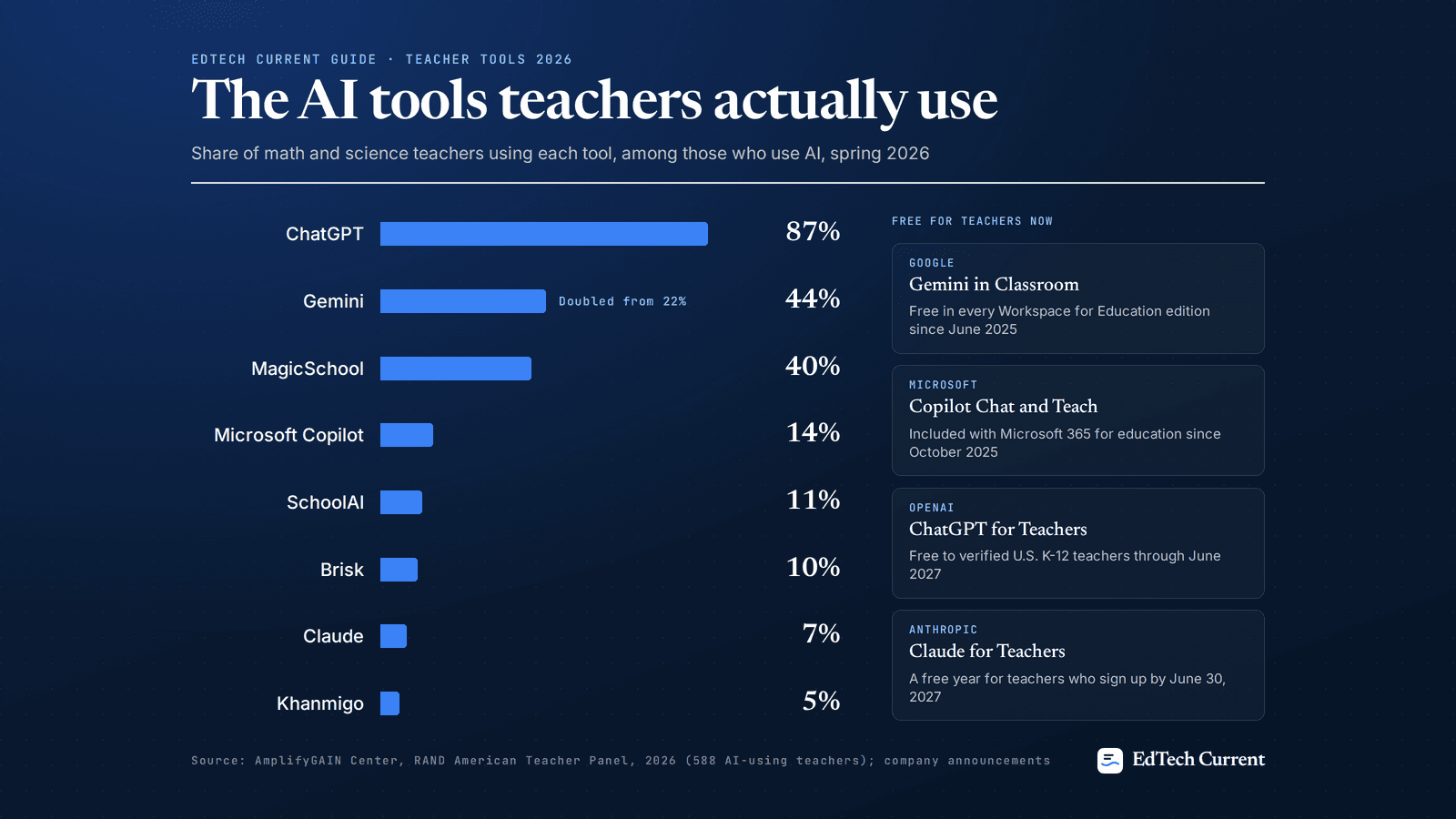
Which AI tools? The clearest answer comes from the University of Washington's AmplifyGAIN Center, which surveyed 1,011 math and science teachers through RAND's panel in spring 2026 (AmplifyGAIN, 2026). Among teachers who use AI, 87% use ChatGPT. Gemini's share doubled in a year, the only statistically significant change. MagicSchool is the most-used specialist tool.
AI tools used by math and science teachers who use AI
Spring 2026
- ChatGPT87%
- Gemini44%
- MagicSchool40%
- Microsoft Copilot14%
- SchoolAI11%
- Brisk10%
- Claude7%
- Khanmigo5%
The survey covers math and science teachers only, and one of its co-authors, Colleague AI, is a vendor.
College instructors have moved faster. Weekly AI use among faculty rose from 30% in spring 2025 to 52% in spring 2026, with a quarter using it daily, according to Tyton Partners' survey with D2L (Tyton Partners, 2026).
The best AI assistants for teachers
Gemini in Google Classroom: best if your school runs Google
Gemini for Education and the 30-plus Gemini tools in Google Classroom have been free in every Workspace for Education edition since June 30, 2025 (Google). In January 2026, Google made its Gemini 3 Pro model free there too and announced a Classroom app inside Gemini (Google, Jan. 21, 2026). It works where many teachers already plan and grade, under their district's existing Google agreement.
Cost: free with Google Workspace for Education.
Watch for: Classroom's AI content tools are only for users designated 18 or older. In Common Sense Media's August 2025 test of AI teacher assistants, Gemini wrote less favorable behavior plans for Black students than for white students (The 74).
Microsoft Copilot and Teach: best for Microsoft 365 schools
Microsoft's Teach module, announced Oct. 15, 2025, drafts lesson plans, quizzes and rubrics and adjusts reading levels. Copilot Chat now also works inside Canvas, Schoology, Brightspace, Blackboard and Moodle (Microsoft).
Cost: Copilot Chat and Teach come with Microsoft 365 for education at no added cost. The full Microsoft 365 Copilot is $18 per user a month for schools and colleges, for users 13 and older.
Watch for: Microsoft's time-savings claims, such as educators at Brisbane Catholic Education saving "over 9 hours per week," come without a published method.
ChatGPT for Teachers: the one most teachers already use
OpenAI launched ChatGPT for Teachers on Nov. 19, 2025, free to verified U.S. K-12 educators through June 2027, with district sign-on and teacher conversations excluded from model training by default (THE Journal). ChatGPT is also the only AI tool tested for time savings in a randomized trial. In England, 259 science teachers using the standard version of ChatGPT spent 31% less time planning lessons, 56 minutes a week instead of 82, and a blinded expert panel found no drop in quality (Education Endowment Foundation).
Cost: free to verified U.S. K-12 teachers through June 2027.
Watch for: consumer ChatGPT is for users 13 and older, with parental consent under 18 (OpenAI). Don't paste identifiable student information into any account your district hasn't approved.
MagicSchool: best specialist toolkit
MagicSchool bundles more than 80 teacher tools, from rubrics and quizzes to reading-level rewrites, plus a chatbot called Raina. It is the most-used specialist AI tool in the AmplifyGAIN survey, at 40% of AI-using math and science teachers, and it holds Common Sense's Privacy Seal with a 95% score (Common Sense Privacy).
Cost: free plan. MagicSchool Plus is $99.96 a year or $12.99 a month. School and district plans are by quote (MagicSchool).
Watch for: in Common Sense Media's risk assessment, MagicSchool, like Gemini, wrote harsher behavior plans for Black students, and it did not flag a debunked claim about Haitian immigrants. Common Sense advises against using any AI assistant to write IEPs, 504 plans or behavior plans. TechCrunch reported in 2024 that Common Sense Media was a MagicSchool investor.
Brisk Teaching: best for feedback inside Google Docs
Brisk works as a Chrome extension on top of Google Docs, Slides and other pages, drafting feedback on student writing, leveling texts and building quizzes from what is on screen. It also holds the Common Sense Privacy Seal, with a 95% score (Common Sense Privacy).
Cost: free plan. Educator Pro has been reported at $99.99 a year; Brisk's pricing page was unavailable when we checked. School plans are by quote.
Watch for: treat feedback drafts as a starting point, and read them before they go back to students.
Khanmigo for Teachers: free, with a privacy caveat
Khan Academy's teacher assistant has been free to U.S. K-12 teachers since May 2024, with Microsoft's backing (GovTech). The most rigorous study of any AI tutor so far, a two-year randomized trial in 18 Tennessee middle schools, found that students assigned Khanmigo gained about 1.3 percentile ranks per term in math, similar to gains from Khan Academy practice without AI, and that most students rarely used the tutor (NBER working paper; Chalkbeat). The paper is not yet peer reviewed. Sal Khan responded that the gains are in line with good math-practice software.
Cost: free for teachers. The student learner plan is $4 a month.
Watch for: Khan Academy carries a Common Sense privacy Warning, with a 78% score, because its policies say user information can be used to target ads on other sites (Common Sense Privacy). The rating page does not mention Khanmigo specifically.
Also worth a look
- Claude for Teachers (Anthropic) launched July 14, 2026, for educators only. Verified U.S. K-12 educators who sign up by June 30, 2027 get a free year. It includes all 50 states' standards and connects to Brisk, Canva, Diffit and MagicSchool (Anthropic).
- Diffit rewrites a text or topic at different reading levels. Common Sense Pass. Free basic plan; paid plans from about $15 a month.
- Eduaide.AI offers 8 free resources a month; Pro is $49.99 a year (Eduaide).
- SchoolAI runs student-facing AI "Spaces" that teachers can monitor. Since July 15, 2026 its free plan is a trial capped at five sessions a year, and paid plans are sold only to schools (SchoolAI). Common Sense gives it a privacy Warning because its policies are unclear on selling data and ad tracking.
- Curipod builds interactive lessons with AI and has a free weekly plan. Common Sense Pass, 68%. Common Sense's AI review flagged a Curipod slide that implied Native Americans no longer exist.
The best classroom platforms and engagement tools
AI gets the headlines, but these are the tools that dominate classroom usage logs. Most of them added AI generators in 2025-26.
Google Classroom and Canvas: where the work lives
Google Classroom ranked first among learning management systems in Instructure's 2025 usage data, ahead of Canvas, Schoology, Savvas Realize and Seesaw. Canvas added its IgniteAI features, including a rubric generator and discussion summaries, in November 2025, and holds a WebAIM accessibility certification against WCAG 2.2 AA (WebAIM). Neither is a teacher purchase; schools and districts license them.
Kahoot!, Wayground and Blooket: quiz games
Kahoot! topped the classroom-response category in Instructure's 2025 data, followed by Blooket, Quizizz (now Wayground), Gimkit and Pear Deck.
- Kahoot! has a free Kahoot! Go plan, paid teacher plans from $36 to $228 a year, and an AI question generator since January 2025. Common Sense Pass, 92%, with the Privacy Seal. Its accessibility report covers only sign-in and player screens, not the teacher's host view.
- Wayground, as Quizizz renamed itself in June 2025, includes AI generation, translation, read-aloud and a dyslexia-friendly font in its free Starter plan. Common Sense Pass, 90%, with the Seal. We found no public accessibility report.
- Blooket is free to start and hugely popular, but it has no current Common Sense rating, and its public accessibility report dates from 2022.
Nearpod and Pear Deck: interactive lessons
- Nearpod has a free Silver plan for up to 40 students per lesson, with Gold at $159 and Platinum at $397 a year (Nearpod). Most of its AI generators need a school or district license. It reports ESSA Level II evidence from a study run by Instructure's LearnPlatform. Its public accessibility report, from 2023, covers only the student lesson view.
- Pear Deck Learning: GoGuardian made its 40-plus AI tools free to all teachers in July 2025 (GoGuardian). We found no published accessibility report, so ask the vendor for one.
Edpuzzle: video lessons
Edpuzzle turns videos into lessons with embedded questions. Instructure's 2026 data, drawn from Canvas launches, called it "the highest-ranked purpose-built educational tool" (Instructure, June 29, 2026). It has a Common Sense Pass at 93% and an accessibility report revised in July 2026 against WCAG 2.2 AA.
Canva, Seesaw, Padlet and Book Creator
- Canva for Education is free for verified K-12 teachers and their students (Canva). There is no current Common Sense privacy page.
- Seesaw remains the default portfolio tool for the early grades. Since June 30, 2026 its free plan is limited to one class per teacher, and school plans start at $2,500 (Seesaw). Common Sense Pass; accessibility report from February 2026 against WCAG 2.2 AA.
- Padlet (Common Sense Pass, 90%, with the Seal) and Book Creator (Pass, 92%) both have free plans. Padlet's accessibility report covers only its Board product.
At a glance
Tool | Best for | Teacher cost (Oct. 2026) | Common Sense privacy | Accessibility report |
|---|---|---|---|---|
Gemini in Classroom | Google schools | Free with Workspace for Education | No current rating | Ask your district |
Copilot Chat and Teach | Microsoft 365 schools | Free with Microsoft 365 for education | No current rating | Ask your district |
ChatGPT for Teachers | Planning and drafting | Free through June 2027 | No current rating | Ask vendor |
Claude for Teachers | Standards-aligned planning | Free year if you sign up by June 30, 2027 | No current rating | Ask vendor |
MagicSchool | All-round toolkit | Free; Plus $99.96 a year | Pass, 95%, Seal | Ask vendor |
Brisk Teaching | Feedback in Google Docs | Free; Pro reported at $99.99 a year | Pass, 95%, Seal | Ask vendor |
Khanmigo for Teachers | Free assistant | Free | Khan Academy: Warning, 78% | Ask vendor |
Kahoot! | Quiz games | Free; $36 to $228 a year | Pass, 92%, Seal | Player screens only (Dec. 2024) |
Wayground | Quizzes with accommodations | Free Starter plan | Pass, 90%, Seal | None found |
Nearpod | Interactive lessons | Free; $159 to $397 a year | No current rating | Student view only (2023) |
Edpuzzle | Video lessons | Free basic plan | Pass, 93% | WCAG 2.2 AA (July 2026) |
Seesaw | Early-grades portfolios | Free for one class | Pass | WCAG 2.2 AA (Feb. 2026) |
Padlet | Collaboration boards | Free plan | Pass, 90%, Seal | Board product only (Jan. 2025) |
Canva for Education | Design | Free | No current rating | Ask vendor |
What the evidence says
The honest summary: AI tools can save teachers planning time, and nothing yet shows that a teacher-assistant product raises student learning.
- The strongest time-savings evidence is the English trial above: 31% less planning time with ChatGPT and no loss in quality.
- We found no independent randomized trial of MagicSchool, Brisk, SchoolAI, Diffit, Curipod, Eduaide, Gemini in Classroom, Copilot's Teach module, ChatGPT for Teachers or Claude for Teachers.
- Evidence ratings for classroom platforms, such as ESSA Levels II to IV for Nearpod, Wayground, Seesaw and Kahoot!, are reported by the vendors themselves, often from studies run by Instructure's LearnPlatform.
- Quality needs checking. A peer-reviewed analysis of 310 civics lesson plans written by ChatGPT, Gemini and Copilot found they mostly targeted lower-order thinking and rarely included diverse perspectives (CITE Journal).
- Common Sense Media rates AI teacher assistants "Moderate Risk" as a category, and says the main risks are bias and unreviewed output, not data handling (Common Sense Media).
Five checks before you use a tool with students
- Ask whether your district has a data privacy agreement with the vendor. The Student Data Privacy Consortium's registry lists more than 244,000 active agreements across 13,177 districts (SDPC), but it needs a district login, so ask your technology office or check its approved-app list.
- Keep student records out of unapproved tools. Under FERPA, a vendor can receive student records without parental consent only as a "school official" under the school's direct control, usually through a contract (Congressional Research Service). Pasting identifiable student information into a personal AI account doesn't meet that test.
- Check the age rules. Consumer ChatGPT requires users to be 13 or older, with parental consent under 18. Gemini's content tools in Classroom are for users designated 18 or older. Copilot is open to students 13 and older. Claude for Teachers is for educators only.
- Look up the privacy rating, and read why. Common Sense rates tools Pass, Warning or Fail, and the reasons behind a Warning differ. Khan Academy's is about ad targeting; SchoolAI's is about unclear policy wording.
- Ask for an accessibility report, and read its scope. A current report against WCAG 2.2 AA makes a tool easier to approve under ADA Title II, but several cover only part of the product. Our guide to the federal accessibility rules has the current deadlines.
Vendors that collect data from children under 13 have also had to comply with the FTC's amended COPPA Rule since April 22, 2026. It requires written data-retention and security policies and separate parental consent before children's data is shared with third parties (Federal Register). The FTC did not adopt the proposed provisions on schools consenting on parents' behalf; its earlier guidance still applies.
"Free" has an expiry date
ChatGPT for Teachers is free through June 2027. The Claude for Teachers sign-up window closes June 30, 2027. SchoolAI and Seesaw cut their free plans in mid-2026, and Canvas's free IgniteAI Agent period ended June 30, 2026. Plan for what happens when a free period ends, and favor tools your district has licensed over accounts you have opened on your own.