Teachers, instructional designers and universities are making more video with AI: cloned voices, avatar lecturers, explainers built from a script in an afternoon. The tools are cheap and fast. The harder question is whether anyone wants to watch the result.
The research gives a two-part answer. AI video is being served at enormous scale, on YouTube in particular. Whether people choose it is another matter, and the evidence there is less flattering. Viewers say they want AI content labeled, can't reliably spot it, and rate it lower once they know. In education, students learn about as much from AI-avatar videos on short tests, but they report lower engagement and say they would rather have a human teacher.
AI video fills the feed
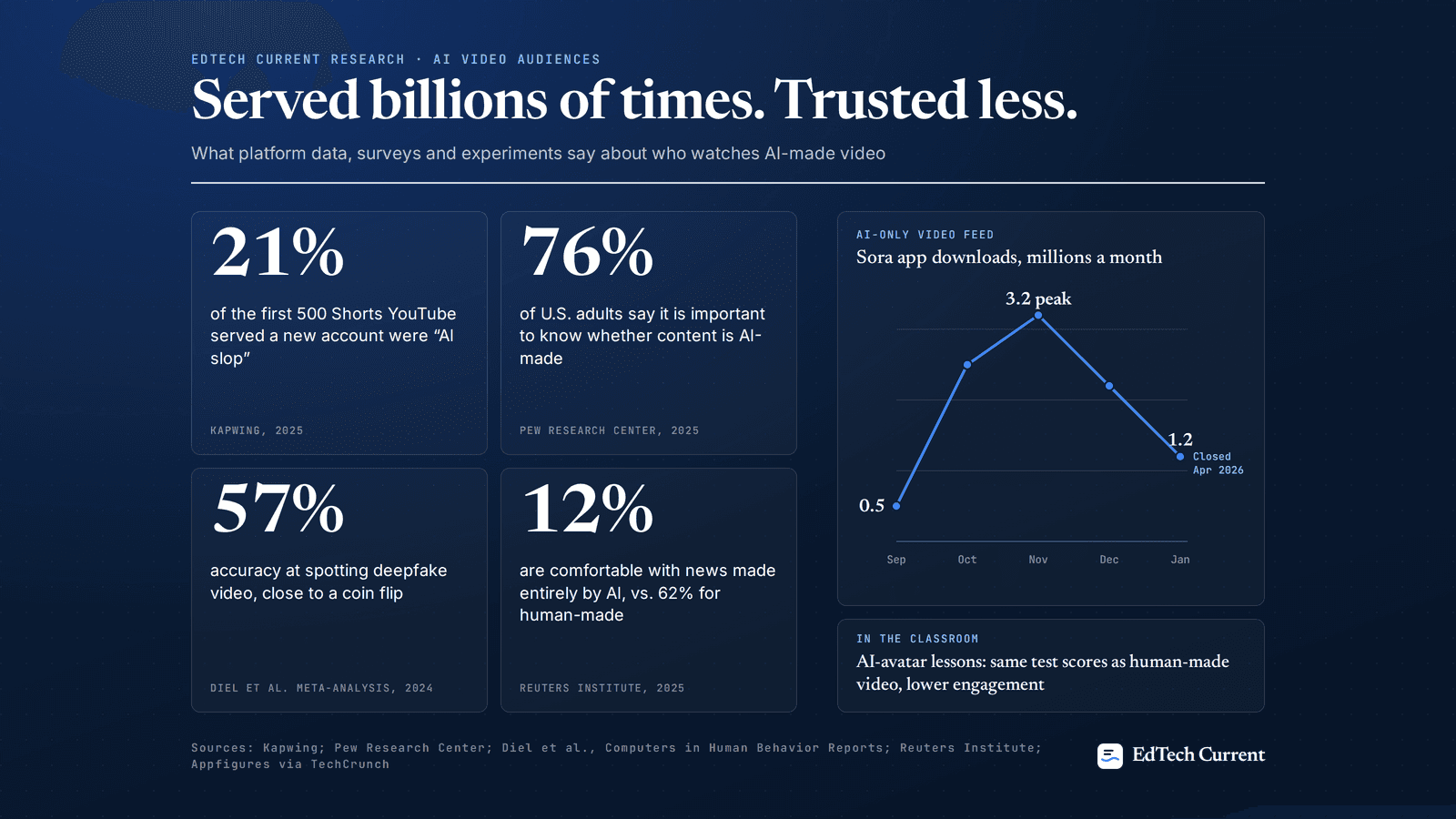
When the video-editing company Kapwing opened a fresh YouTube account in October 2025, 104 of the first 500 Shorts it was served, or 21%, were what it classed as "AI slop" (Kapwing, Nov. 28, 2025). Another 33% were "brainrot," a category Kapwing says is often, but not always, AI-made. Its scan of trending channels found AI-only channels with billions of views, led by India's Bandar Apna Dost at 2.07 billion views and an estimated $4.25 million a year in ad revenue. Kapwing sells AI video tools, and it warns that its revenue estimates "may be inflated or unstable."
YouTube's own numbers show the scale. Shorts average 200 billion daily views, and more than a million channels used YouTube's AI creation tools daily in December 2025, CEO Neal Mohan wrote in his annual letter (YouTube, Jan. 21, 2026).
None of these figures says whether people watched to the end, came back, or liked what they saw. A Shorts view is mostly an impression the algorithm chose to serve. No platform publishes the share of watch time that goes to AI content, and we found no study comparing retention of AI-made and human-made videos on a real platform.
Feeds made only of AI video faded fast
The clearest test of demand came when companies built feeds of nothing but AI video.
OpenAI's Sora app launched on Sept. 30, 2025 and reached No. 1 on the U.S. App Store. Downloads peaked at 3.2 million in November, then fell 32% in December and 45% in January, according to Appfigures data reported by TechCrunch. Over its life the app drew 9.6 million downloads but only $1.4 million in consumer spending. OpenAI closed it on April 26, 2026, citing focus and computing costs (Engadget).
Sora app downloads by month
Millions of downloads
| Rank | Item | Value |
|---|---|---|
| 1. | Sept 2025 | 0.5M |
| 2. | Oct 2025 | 2.5M |
| 3. | Nov 2025 | 3.2M |
| 4. | Dec 2025 | 2.2M |
| 5. | Jan 2026 | 1.2M |
Meta's Vibes, an AI-video feed inside its Meta AI app, launched on Sept. 25, 2025. Similarweb estimated that daily users of the Meta AI app rose to about 2.7 million within four weeks, from about 775,000, though it could not show that Vibes caused the rise (TechCrunch, Oct. 20, 2025). Internal documents later put Vibes at about 2 million daily users, growing about 1% a week, Business Insider reported.
Making AI video, meanwhile, is booming. Google says its Flow tool produced more than 275 million videos by October 2025. The gap between how much AI video gets made and how little appetite there is for feeds of nothing else is the clearest signal the market has given so far.
Viewers want labels, and can't tell on their own
In a Pew Research Center survey of 5,023 U.S. adults, 76% said it is extremely or very important to be able to tell whether pictures, videos and text were made by AI, and 53% said they are not confident they can (Pew, Sept. 17, 2025). In a companion analysis, Pew reported that 56% would react negatively to learning a news article was AI-written and 49% would like a painting less if they found out AI made it. Younger adults reacted more negatively than older ones.
They are right to doubt themselves. A meta-analysis of 56 studies with 86,155 participants put people's accuracy at spotting deepfake video at 57%, with a confidence interval that includes chance (Diel et al., Computers in Human Behavior Reports, 2024). Those studies predate the newest video generators.
News audiences show how comfort drops as AI takes over. In the Reuters Institute's six-country survey, 62% were comfortable with news made entirely by humans and only 12% with news made entirely by AI. Just 19% were comfortable with artificial presenters (Reuters Institute, Oct. 7, 2025).
Comfort with news, by how it is made
Share comfortable, six countries
- Entirely by humans62%
- Mostly human, with AI help43%
- Mostly AI, with human oversight21%
- Entirely by AI12%
What an "AI-generated" label does
Experiments that show people the same content with and without an AI label find a consistent penalty on trust. The effect on what people actually do is smaller and less consistent.
- Short video. In a study of 618 short-form video users, the same human-made clip was rated as taking less effort when labeled "AI-generated" (3.48 vs 4.19 unlabeled), and the label lowered people's intention to like, save or follow (Lim et al., Frontiers in Psychology, June 3, 2026). The study measured intentions, not behavior.
- Headlines. With 4,976 participants, an AI label cut perceived accuracy and willingness to share by about 2 to 3 percentage points, even for true headlines written by people. The penalty disappeared when the label said AI had only helped draft or edit (Altay & Gilardi, PNAS Nexus, 2024).
- Images. In a study of 7,579 U.S. adults, an "AI-Generated" label lowered belief in misleading images but had no significant effect on sharing (Wittenberg et al., PNAS Nexus, 2025).
- News. Readers trusted an outlet less when its articles were labeled as AI-made, but listing the article's sources largely offset the penalty, according to research by Benjamin Toff and Felix Simon reported by Nieman Lab.
The lesson runs through all of them: people read a bare "AI" label as "no human involved." Saying what the human did shrinks the penalty.
Platforms now label it for you
YouTube has required creators to disclose realistic synthetic content since March 2024 (YouTube). On July 15, 2025 it renamed its "repetitious content" monetization rule to "inauthentic content," covering mass-produced and repetitive videos; YouTube called it a minor update, not a ban on AI (YouTube Help). In his January 2026 letter, Mohan named "AI slop" as a concern and said that "because labels aren't always enough, we remove any harmful synthetic media." In May 2026, YouTube began labeling photorealistic AI video automatically, even when creators don't disclose it, Music Business Worldwide reported.
Enforcement has reached the biggest channels. YouTube terminated the fake AI movie-trailer channels Screen Culture and KH Studio, which had well over a billion views, in December 2025 (TheWrap). By late January 2026, at least 18 channels from Kapwing's list had been deleted or had their videos hidden (Tubefilter).
TikTok has labeled AI content from other platforms automatically since May 2024, using Content Credentials metadata, and says it has labeled more than 1.3 billion videos. In November 2025 it began testing a setting that lets users see less AI content in their For You feed (TikTok, Nov. 19, 2025). That a platform built a "see less AI" control at all says something about what its users asked for.
In the classroom: the same scores, less engagement
For educators, the more important question is whether students learn from AI-made video. Every controlled comparison we found from 2023 to 2026 points the same way: on short tests taken right after watching, students who learned from an AI avatar scored about the same as students who watched a human-made video. They liked it less.
Study | Who took part | Learning | Engagement and preference |
|---|---|---|---|
100 undergraduates in a real course | No difference (7.29 vs 7.35) | Engagement much lower with the AI instructor (46.8 vs 59.5) | |
447 online participants, avatars cloned from the real teachers | Same exam results | Human videos rated a better learning experience | |
76 university students | AI group remembered slightly more; no difference on applying it | Students felt more social presence with the human | |
74 undergraduates, 17-minute lecture | No difference | 72% didn't notice the AI; 84% prefer human instruction | |
83 adults | No difference | No difference |
A January 2026 review of 15 studies reached the same conclusion on learning (Hai, Mai & Nguyen, Frontiers in Computer Science). The limits matter, though. Every test was short, a single session of 17 minutes or less. Several studies didn't tell participants the instructor was AI. Most cloned the real instructor's face and voice. No study has followed AI-avatar video across a semester or tracked course completion, and we found no K-12 classroom trial.
Older research helps explain the pattern. Modern synthetic voices generally match recorded human narration on learning, unlike the robotic text-to-speech of earlier studies. And a meta-analysis of 20 experiments found that showing an instructor on screen did not significantly improve learning, but did raise motivation (Alemdag, 2022). Swapping a face for an avatar rarely moves test scores. Motivation is where avatars fall behind.
The best data on real viewing behavior predates generative AI, but it still applies. An analysis of 6.9 million edX video sessions found that median engagement is at most six minutes, whatever the video's length, and that informal videos filmed at a desk held viewers longer than polished studio productions (Guo, Kim & Rubin, 2014). The personal, direct presence of a teacher is exactly what avatars do least well.
Disclosure has a cost of its own. In a small preprint study, economics students told that a video featured an AI replica of their professor valued it less than students who weren't told (Rosa-García, MPRA). But hiding it is worse. At the University of Staffordshire in England, apprentices complained to The Guardian in November 2025 that a course was taught largely with AI slides and an AI voice. "If we handed in stuff that was AI-generated, we would be kicked out of the uni, but we're being taught by an AI," one said.
The case for AI video is speed. In the Netland study, the AI versions took a few hours to make, against several days for the recorded ones, the lead author wrote. Vendor claims of higher completion rates, such as Synthesia's "8x" engagement figure for one client, rest on case studies without a usable comparison.
What this means if you make video for students
- Use AI to prepare, and keep yourself in front of students where it counts. Introductions, feedback and anything relational are where human presence earns its keep.
- If you use an avatar or a cloned voice, say so, and say what you did. "An AI avatar of me, reading a script I wrote" carries a smaller penalty than a bare "AI-generated" label.
- Keep videos short. Six minutes is the attention ceiling the best data supports, AI or not.
- Don't hide it. Students are already told not to submit AI work as their own.
- Check your own analytics. No published study tracks whether students finish AI-made course videos. Your learning management system can show you watch time for your own.
- If you post publicly, follow the platform rules. YouTube requires disclosure of realistic synthetic content, and templated, mass-produced videos can lose monetization.