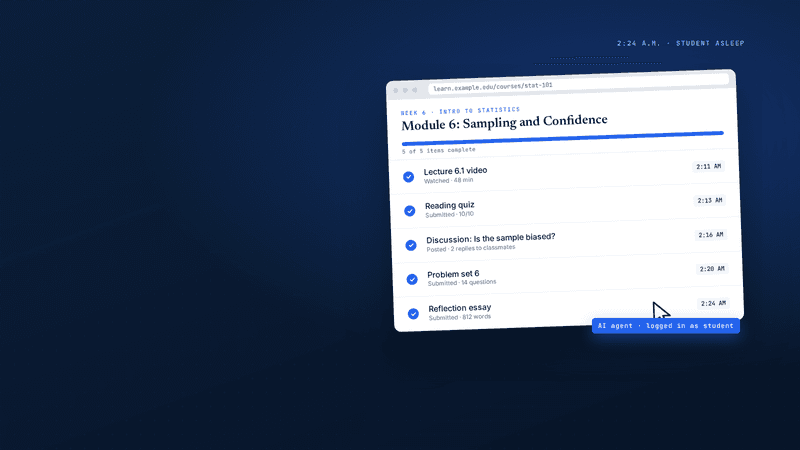
Richard Borcherds won the Fields Medal, mathematics' highest honor, in 1998. Now the University of California, Berkeley professor has stopped grading his students' homework for correctness. They get credit for handing it in.
"AI can now solve many undergraduate mathematics problems, often better than the students themselves," Borcherds told Newsweek in an email in October. "This makes it increasingly difficult to tell whether a homework solution represents the student's own understanding or was generated by AI."
He is not alone. Across math classrooms, a correct answer on a take-home problem set no longer tells a teacher who did the thinking. So teachers are changing what they grade. This case study looks at four of them, and at the evidence behind the shift.
The evidence: practice went up, learning went down
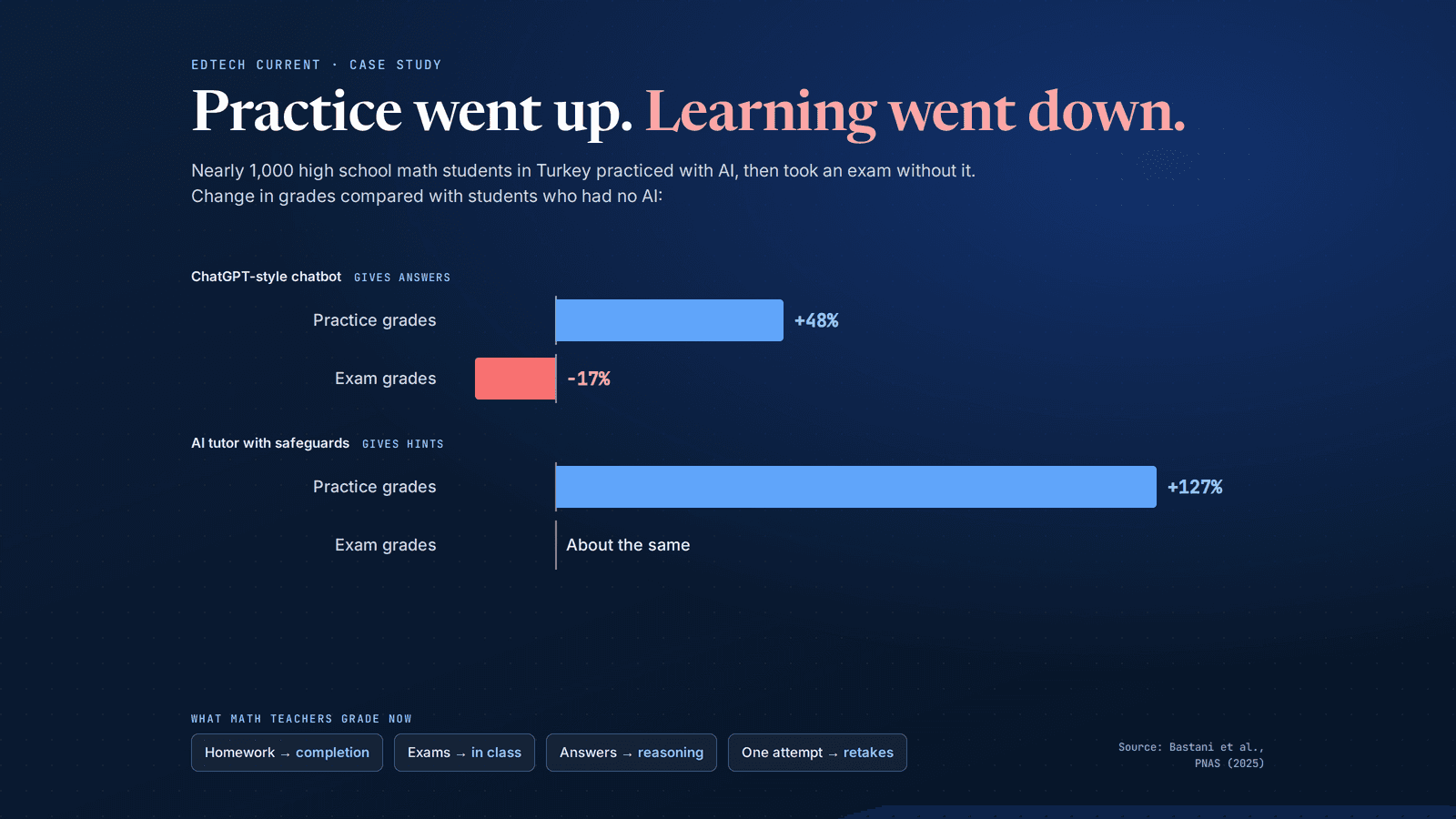
The clearest data comes from a field experiment with nearly 1,000 high school math students in Turkey, published in PNAS in July 2025 (Bastani et al.). Students practiced with either a ChatGPT-style chatbot ("GPT Base"), a tutor version that gave hints instead of answers ("GPT Tutor"), or just their textbook and notes. Then all of them took an exam without AI.
Grades compared with students who had no AI
Percent change vs. no AI
- Practice, chatbot+48
- Practice, tutor+127
- Exam, chatbot-17
- Exam, tutor0
With the plain chatbot, practice grades rose 48%, but exam grades fell 17% below students who never had AI. The tutor version raised practice grades 127% and left exam grades about the same as the control group. Hamsa Bastani, the Wharton professor who led the study, warned that students who use the tools "as a crutch" won't "build those fundamental skills" (Wharton).
Two more data points show how widespread the shortcut is:
- Word problems. Researchers from the University of California, Irvine and McGraw-Hill studied 3.2 million student math problems on the ALEKS platform. After ChatGPT arrived, high school students spent 31% less time on word problems, the kind easiest to paste into a chatbot, and college students 27% less. Under proctored conditions without AI, the odds of answering those problems correctly fell by 25%. "What's new now is that, with all the gen AI stuff, the cost of taking a shortcut is zero," said Eric Cosyn of ALEKS (The 74).
- Top students use it too. In a survey of more than 1,300 high school students in the MathWorks Math Modeling Challenge, run by the Society for Industrial and Applied Mathematics, 68% said they use AI for math assignments or exams. About a third use it to check their answers (MyChesCo). These are competition students who chose to answer, not a representative sample.
Case 1: The research university stops grading homework for correctness
Borcherds' reasoning is about incentives. "I hope that removing grades for correctness will reduce the incentive to just ask AI for answers and increase the chance that they do the homework themselves," he told Newsweek. "Students still need to understand the material to do well on examinations."
What gets graded now: homework counts for completion; understanding is measured on supervised exams. Borcherds said "in-person exams still work fine for assessing students," but admitted the hard part remains unsolved: "Assessing students in online courses is now hard because of AI, and I do not know of a good solution."
Case 2: The high school teacher who stopped sending problems home
Al Rabanera teaches math at La Vista High School in Fullerton, California. He doesn't pretend AI isn't there. "I'm not going to pretend like you aren't," he tells his students. "I know it's readily available for most of you, if not all of you" (The 74).
He stopped sending home problems that can be lifted wholesale into a chatbot. Instead he built a car-buying unit on interest, monthly payments and credit scores, assigns poster projects and in-class design challenges, and has students write their own word problems to show they understand the concepts.
What gets graded now: work that is personal, made in class, or both, so that the student's own thinking is visible.
Case 3: The 80/20 policy
Dan Meyer, a former high school math teacher who writes about math education, published a new grading policy in October, written as a resolution to his students. As quoted by Eric Hudson in his newsletter, it reads in part:
"[E]xams will count for 80% of your final grade. These will be taken in-class and without the assistance of AI."
Homework is "worth 20% of your final grade and will be graded on a complete / incomplete basis only."
"[Y]ou may use AI in any capacity on homework. If you copy and paste the assignment into an LLM and turn in the result, you will receive a score of 'complete,' no questions asked."
What gets graded now: a clean split. Homework becomes practice with no penalty for honesty, and the grade comes from work done in the room. (Read Meyer's full policy.)
Case 4: The department that is rethinking together
At Columbia University, "the math department has launched a working group, introduced more recitation sections, and has partially embraced oral presentations or examinations," the Columbia Spectator reported in September.
Oral exams are not new in math. At the University of Pennsylvania, mathematics professor Phil Gressman replaced a written final with individual oral exams in 2020. "I felt like I got a better sense of what's going on," he said (Newsweek). The catch is scale: talking with every student works in a seminar, not easily in a 100-student calculus lecture.
What gets graded now: explanation. Students show they can talk through a solution, not just produce one.
The pattern: what math grades measure now
Then | Now |
|---|---|
Homework graded for correct answers | Homework graded for completion, or not graded, and treated as practice |
Take-home tests and online quizzes | In-class or proctored exams, sometimes offered on several days |
The final answer | The reasoning: annotated steps, short "explain your thinking" check-ins, oral exams |
One attempt per test | Mastery checkpoints with retakes to show growth |
Generic problem sets | Personal, project-based or class-specific problems |
Northern Illinois University's teaching center put the underlying problem plainly: "The problem, then, is not that students are using AI. It's that foundational math courses may still rely on assessment structures that assume students cannot outsource cognition, and in the age of AI, that's no longer true" (NIU CITL). The National Council of Teachers of Mathematics made a similar point in its position statement on AI, urging teachers to make sure assessments "focus students on identifying the reasonableness of the output" (NCTM).
The trade-offs
Moving every grade into a timed, in-person exam has costs. "What I caution against is designing assessments solely to protect against AI," said Eric Klopfer, a professor at MIT. "Blue book exams might test memory, but not thought. In subjects where thinking is the goal, they don't validly assess what matters" (Newsweek).
Oral exams take time, and homework graded for completion only works if students still choose to practice. Klopfer also noted that "at least for some students, homework is no longer a valid evaluation of their learning." The Turkey study suggests one more option: AI built to tutor rather than answer did not hurt exam results. For math teachers, the question is shifting from "did they get it right?" to "can they show me how?"
Sources
- Generative AI without guardrails can harm learning: Evidence from high school mathematics. PNAS (2025)
- Berkeley Professor Stops Grading Homework Over AI—How Teachers Are Adapting. Newsweek (2026)
- The End of Homework? Teachers Grapple With Cheating in the Age of AI. The 74 (2026)
- What if we just gave up on homework?. Eric Hudson (Substack) (2026)
- Updating My Grading Policy Because You’re All Using AI All The Time. Dan Meyer (Substack) (2026)
- ‘Math is being disrupted’: Columbia math professors reckon with AI. Columbia Spectator (2026)
- When homework isn’t proof of learning: Assessing foundational math in the AI era. NIU Center for Innovative Teaching and Learning (2026)
- Survey Finds Most Top Math Students Use AI for Coursework. MyChesCo (2026)
- Without Guardrails, Generative AI Can Harm Education. Knowledge at Wharton
- Artificial Intelligence and Mathematics Teaching. National Council of Teachers of Mathematics