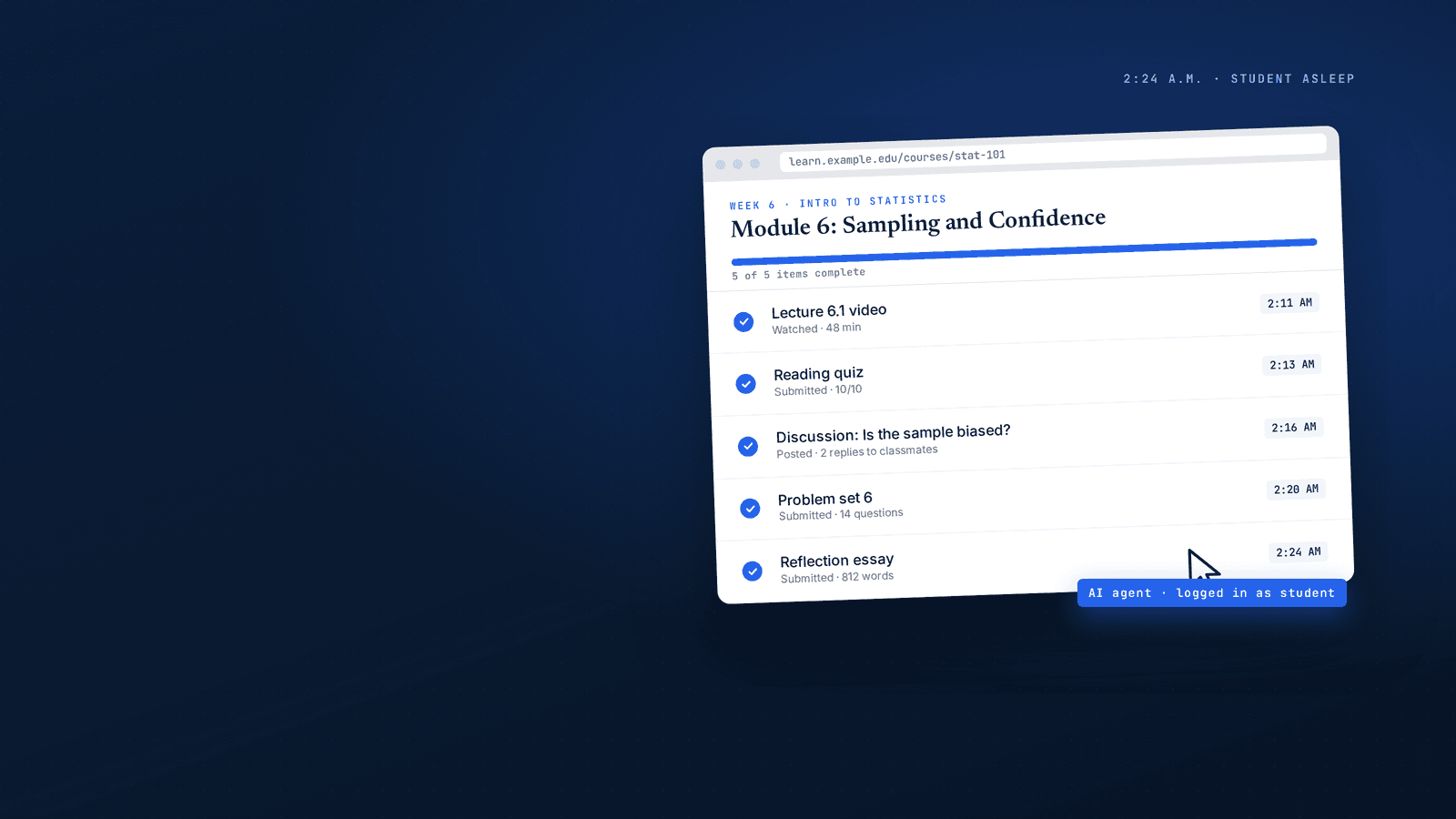
In late February, a 22-year-old entrepreneur launched a product that said out loud what many instructors already feared. "Einstein is an AI with a computer," its website read. "He logs into Canvas every day, watches lectures, reads essays, writes papers, participates in discussions, and submits your homework—automatically," Inside Higher Ed reported.
The tagline was blunter: "Stop stressing. Start acing. Einstein does the busywork so you don't have to." Access cost $40 to $200 a month, and the tool would keep working while students slept, according to Times Higher Education.
Einstein was gone within days. Its creator, Advait Paliwal, said he received cease-and-desist letters from Instructure, which owns Canvas, and from CMG Worldwide, which manages the rights to Albert Einstein's name on behalf of the Hebrew University of Jerusalem (Inside Higher Ed; Times Higher Education). But the capability Einstein advertised did not disappear with it. Months later, reporting by The New York Times found that AI companies "have not prevented agents from logging into learning platforms such as Canvas, Brightspace and Blackboard" (The New York Times, via a syndicated reprint).
What Einstein did, and why its creator built it
An AI agent is different from a chatbot. A chatbot writes an essay when asked; an agent uses a computer the way a person does, clicking through pages, filling in forms and pressing submit. Einstein took a student's Canvas login and worked inside the course on their behalf.
Paliwal, who dropped out of Brown University's computer science master's program in 2024, told Inside Higher Ed the idea came after a student co-worker complained about an assignment and he suggested the tool complete it. "It did it, which was very unexpected for me. I started questioning more and more about what it means to be a student," he said.
He framed the launch as a warning. "My fear was that if no one realizes the capability of this project, then the right change won't happen," he said. "Or if it happens it'll be too late." He said more than 124,000 people visited the site in three days, mostly faculty.
Faculty were not reassured. David Hitchcock of Canterbury Christ Church University called it the "most thorough example of an automated contract cheating engine that we have seen so far," one that "erases the process of learning entirely." Damien Williams of the University of North Carolina warned that handing login access to an "unknown third party" was "extremely dangerous" (Times Higher Education).
It was never just one tool
Einstein was the most explicit version of something the large AI companies already sell. In October 2025, a developer posted a 16-second clip of Perplexity's Comet browser completing what appeared to be a 45-minute Coursera assignment from the prompt "Complete the assignment." Perplexity had just made Comet free for students. Its chief executive, Aravind Srinivas, replied on X: "Absolutely don't do this" (Fortune).
In August, The New York Times tested the tools students use most. None of ChatGPT, Gemini or Grammarly said no when asked to write a paper on a student's behalf. Google and OpenAI did not respond to questions about their agents posing as students; in written statements, both said they were working with educators to protect learning. Perplexity said that limiting agents or requiring them to identify themselves "would put the student's privacy and security at risk" (The New York Times).
How AI agents reached the online classroom
A browser completes a Coursera assignment in 16 seconds
Perplexity’s CEO responds to a viral clip of its Comet browser: “Absolutely don’t do this.”
Fortune ↗Einstein launches, promising to do Canvas coursework
It logs in as the student, watches lectures, posts in discussions and submits work, for $40 to $200 a month.
Inside Higher Ed ↗Einstein goes dark
Cease-and-desist letters arrive from Instructure and from CMG Worldwide, which manages the rights to Einstein’s name.
Times Higher Education ↗Canvas launches an AI agent for instructors
Instructure says its agent can’t detect student agents and that AI judging AI is “a recipe for disaster.”
Inside Higher Ed ↗Latest
The New York Times: agents can still log in
Platforms say there is no fail-safe way to block agentic cheating.
The New York Times ↗
Why detectors can't see it
Most cheating tools look at the work: does this essay read like AI? An agent changes the question, because it does the whole job through the student's own account, in the same browser a student would use.
Learning platforms told the Times they can look for signals such as time on task, but that "there is no fail-safe way to block agentic cheating, though they are researching it." Blackboard's chief of staff, Jason Weaver, said: "Our customers are making it clear that there has never been more pressure on academic integrity." Blackboard has bought an app that learns students' typing patterns to authenticate their work (The New York Times).
Instructure's own new AI agent for instructors won't police students either. "Asking AI if something came from AI is a recipe for disaster and disappointment," said Zach Pendleton, Instructure's chief architect. "Large language models aren't especially great at being able to reason about the performance or presence of other LLMs" (Inside Higher Ed).
Why it matters beyond cheating
Online learning is no longer a niche. More than half of American college students took at least one online class last year, up from about a third in 2019, the Times reported. If no one can tell who did the work, the credential itself is at risk. "Their credits will be suspect and won't count in the job market unless we can do something about this," said Anna Mills, an English instructor at the College of Marin who has written an open letter asking AI companies to stop their systems "from pretending to be students" (Inside Higher Ed).
The Modern Language Association warned in October 2025 of "a fully automated loop": AI completing assignments that AI then grades (Inside Higher Ed). Jason Gulya of Berkeley College put it more starkly. "Ed tech is often pushing us toward that dead classroom theory," he told Inside Higher Ed. Instructure says it wants to avoid AI agents grading AI agents' work, which Pendleton called dystopian (Inside Higher Ed).
What colleges are doing
The response so far is uneven, the Times found: some professors shrug, some hand out poor marks and some allow unrestricted AI use. A pattern is emerging among those who act:
- Bringing some assessment back into the room. Kathryn Kysar, a community college instructor since the 1980s, now requires in-person midterm and final exams for some classes. Marina Aminy, executive director of California Virtual Campus, suggested "a classroom-based exam offered on multiple days" so online students keep flexibility (The New York Times).
- Redesigning assignments around personal responses, reflections and work that draws on what happened in class, which are harder for AI to fake.
- Authenticating the student, not the essay, through typing patterns, live check-ins or short oral defenses of submitted work.
- Asking for rules. Some faculty have called for regulation of the AI tools students use, and Mills's letter asks OpenAI, Perplexity, Google and Anthropic to make agents identify themselves.
Paliwal's prank worked in one sense: it made the problem impossible to ignore. "We have to move quickly," said Michelle Kassorla of Georgia State University's Perimeter College, "because AI isn't going to wait for us."
Sources
- Agentic AI Can Complete Whole Courses for Students. Now What?. Inside Higher Ed (2026)
- Strange case of “Einstein AI” spotlights chatbot concerns. Times Higher Education (2026)
- Canvas Unrolls AI Teaching Agent. Inside Higher Ed (2026)
- AI cheating threatens the value of online degrees. The New York Times (2026)
- Perplexity’s CEO after a student used his AI browser to cheat: “Absolutely don’t do this”. Fortune (2025)
- Instructure launches IgniteAI Agent. Instructure (2026)