Updated Oct. 20, 2026.
How much do big universities spend on technology? There is no public ranking that answers the question. Universities aren’t required to report IT spending in a common format, and the federal IPEDS database has no line for it. Most institutions don’t publish their central IT budgets at all, and those that do define them differently.
So we went to the documents that are public: university budget pages, board approvals, legislative reports, audits and student newspaper reporting on the biggest system projects. Here is what they show.
The numbers at a glance
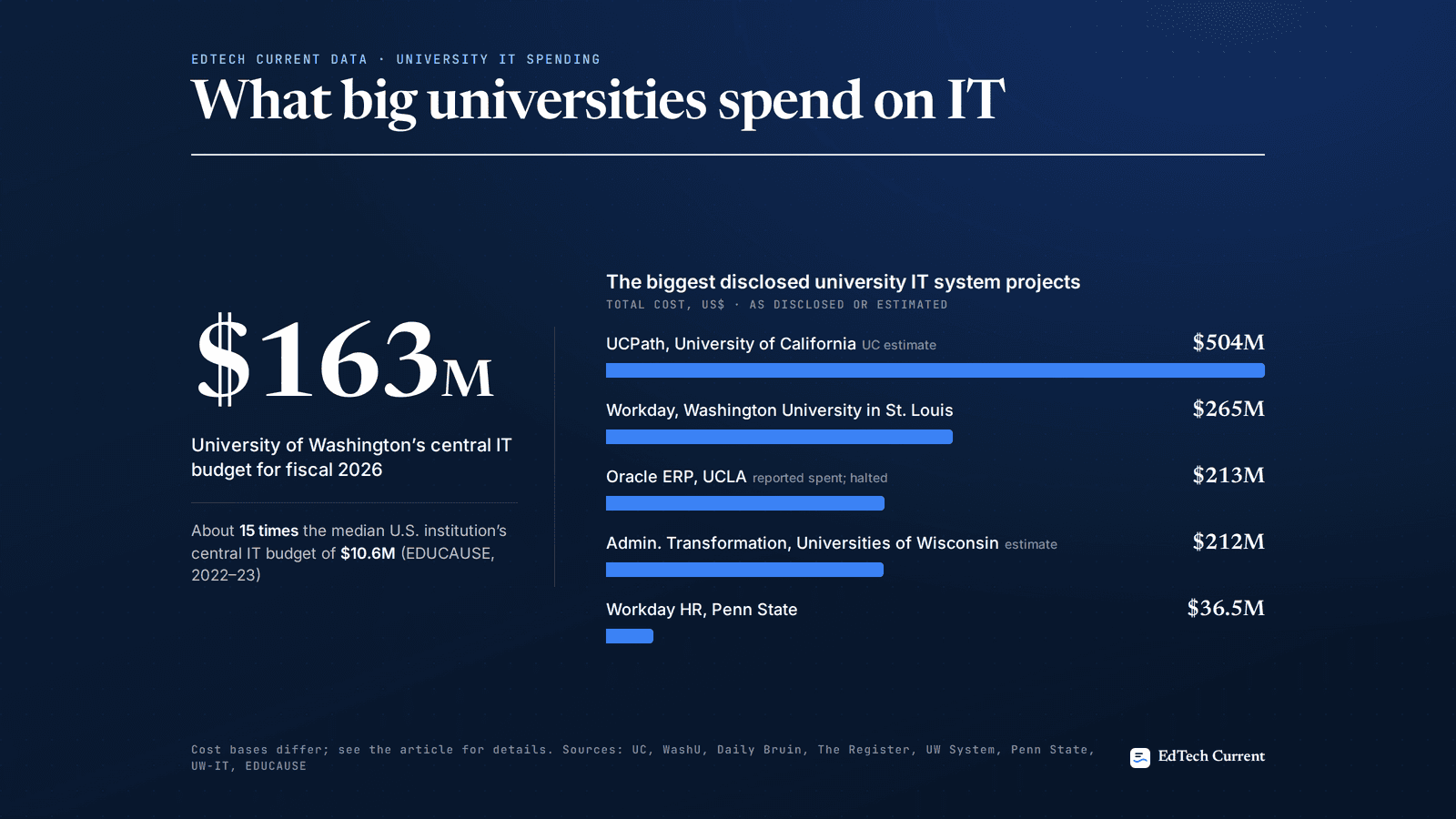
- $163 million: the University of Washington’s central IT budget for fiscal 2026, published by UW-IT.
- About 15 times the median U.S. institution’s central IT budget of $10.6 million in 2022–23, from EDUCAUSE’s Core Data Service.
- $504 million: the University of California’s own estimate for UCPath, its systemwide payroll and HR system. A state audit put the full cost at $942 million.
- $265 million: what Washington University in St. Louis spent on Workday and its new student system over at least seven years, plus about $29.5 million a year to run them.
The biggest disclosed IT bills
The biggest disclosed university IT system projects
Total cost, US$ millions
- UCPath, University of California$504M
- Workday, WashU$265M
- Oracle ERP, UCLA (spent; halted)$213M
- Admin. Transformation, Univ. of Wisconsin$212M
- Workday HR, Penn State$36.5M
The largest IT expenses universities disclose aren’t laptops or networks. They’re enterprise resource planning (ERP) systems: the payroll, HR, finance and student-records software that runs the institution. The figures above aren’t measured the same way, so here is what each one includes:
Project | Cost | What the figure is | Source |
|---|---|---|---|
UCPath (University of California) | $504M | UC’s estimate in 2017, up from $175M in 2011. A 2017 state audit estimated $942M including operations, financing and campus costs, which UC disputed | |
Workday and Student Sunrise (WashU) | $265M | Total over at least seven years, per the CFO | |
Ascend, Oracle ERP (UCLA) | $213M | At least this much spent, per the Daily Bruin, against a $98.9M revised budget reported to UC regents. UCLA moved to end the project in 2025 | |
Administrative Transformation (Universities of Wisconsin) | $212M | Estimated total cost when regents approved it in 2020 | |
WorkLion, Workday HR (Penn State) | $36.5M | Total capital cost with a 2015 funding request |
Outside the U.S., the University of British Columbia’s Workday program had a total expected cost of C$335.9 million, The Ubyssey reported in 2020.
WashU: where $265 million went
Washington University’s Workday and Student Sunrise costs
US$ millions
- Student Sunrise, including Workday Student$98.9M
- Workday HR and finance$81M
- Planning, data integration and other costs$56.5M
The one-time cost isn’t the whole bill. WashU spends $23.8 million a year on Workday support teams and operations in fiscal 2026, plus a $5.7 million annual license fee, according to CFO David Gray. The student project replaced nearly 80 older systems. “It is hard to see how a software transition should cost a quarter of a billion dollars,” Michael O’Bryan, a senior lecturer and the AAUP chapter’s secretary, told Student Life.
What a $163 million IT budget buys
The University of Washington publishes one of the most detailed central IT budgets in higher education. Its fiscal 2026 plan shows where the money goes.
UW-IT planned spending by area, fiscal 2026
US$ millions
- IT infrastructure$60.6M
- Administrative systems$47.3M
- IT management$19.8M
- Risk, security and accessibility$16.7M
- Collaboration and licenses$10.8M
- Teaching and learning$4.2M
- Research computing$3.6M
Inside those categories:
- Infrastructure ($60.6M): data networks ($19.1M), computing and storage ($18.5M), identity and access management ($10.2M), regional networks, data centers and telecommunications.
- Administrative systems ($47.3M): financial systems alone cost $24.6M, followed by data analytics ($7.0M) and student systems ($6.4M).
- Risk ($16.7M): information security and privacy ($9.6M), accessibility ($4.6M) and emergency preparedness ($2.5M).
- New money: $8.2M in provost reinvestment funding for enterprise AI, digital accessibility, emergency wireless communications and security.
How UW-IT is funded, fiscal 2026
US$ millions
- State funds, tuition and indirect cost recovery$68.6M
- Self-sustaining operations$36.7M
- Technology recharge fee$33.2M
- Workday sustainment$21.6M
- Carryover$3M
How big budgets compare
Only a handful of large universities publish a central IT budget, and they don’t all count the same things. With that caveat, here are the published figures we could verify, against the national median.
Published central IT budgets at large universities
US$ millions, year as noted
- University of Washington (FY2026)$163.1M
- Stanford University (2018)$150M
- University of Arizona, all IT (FY2022)$141M
- NC State University (FY2024)$78M
- EDUCAUSE median institution (2022–23)$10.6M
- University of Washington: $163.1M, fiscal 2026 (UW-IT).
- Stanford: about $150M and 550 staff when it named its first CIO in 2018 (Campus Technology). Stanford hasn’t published a more recent figure we could find.
- University of Arizona: $140.98M in total central and campus IT spending in fiscal 2022; the central CIO division alone had an operating budget of about $77.6M and more than 350 employees, according to a 2024 faculty committee review.
- NC State: $78M for its Office of Information Technology in 2023–24, 55% for personnel (NC State OIT).
- The median: EDUCAUSE’s Core Data Service put the median central IT budget at $10.6M in 2022–23, with the middle half of institutions between $4.8M and $25.3M (EDUCAUSE data compiled by Risely).
Median central IT spending per student
Per FTE student
$1,601
median central IT spending per FTE student, 2022–23+403 Per FTE student
Measured against total spending, central IT typically accounts for about 4% to 5% of a university’s budget. EDUCAUSE data put it at 4.2% in 2020–21, and John Rathje, a former Kent State CIO now at CDW, puts it “somewhere in the neighborhood of 5%” (EdTech Magazine). One caution on the per-student figure: the number of institutions reporting to EDUCAUSE has fallen from about 680 to 320–400 in recent years, so year-to-year comparisons are approximate.
The squeeze in 2026
These budgets are under pressure. Federal research funding cuts and caps on indirect cost reimbursement are hitting the units that pay for research computing and shared infrastructure, EdTech Magazine reported in August. Johns Hopkins laid off more than 100 employees after its federal research portfolio fell by more than $500 million, and MIT says federally funded research on campus is down more than 20%.
IT organizations are feeling it directly. Harvard laid off 38 IT workers in November 2025, with CIO Klara Jelinkova citing “significant financial challenges” at the university level, The Crimson reported. Washington University cut the budget of its central fiscal unit, which includes IT, by nearly 8% for fiscal 2026 (Student Life).
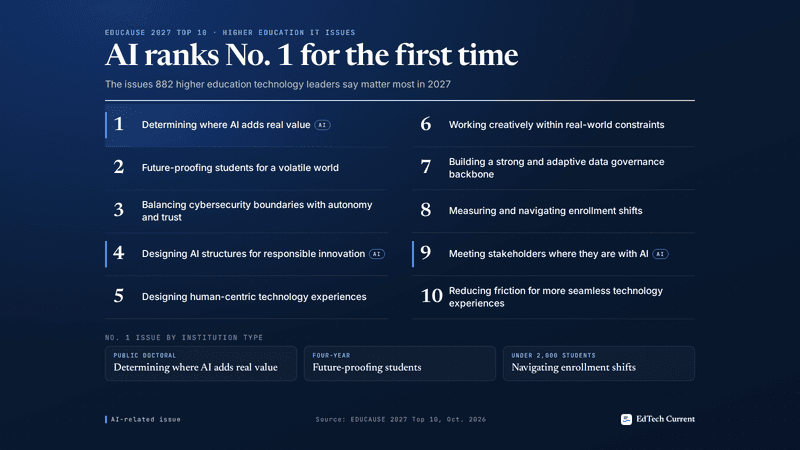
At the same time, demand is rising. “Determining where AI adds real value” tops the 2027 EDUCAUSE Top 10, and accessibility deadlines are adding work: UW’s budget alone sets aside $4.6M for accessibility. Our guide to the federal accessibility rules has the dates.
Lessons for anyone buying campus technology
- Budget for the decade, not the launch. WashU’s ongoing Workday costs (about $29.5M a year) will overtake its one-time HR and finance build within three years.
- Treat savings projections skeptically. UC’s 2011 business case projected large savings from UCPath; the 2017 state audit concluded the project would produce none because several campuses didn’t plan to cut staff (Daily Bruin).
- Negotiate an exit. UCLA spent heavily on Oracle before halting the project; its 2026 settlement recovered $3.1M in credits and $1.31M in waived fees (The Register). Termination rights and functional acceptance tests matter.
- Count consultants separately. Implementation partners can rival the software cost. The Universities of Wisconsin spent $121M on Huron Consulting from 2013 to 2023, Student Life reported, citing prior coverage.
- Publish the numbers. The institutions in this story are the exceptions that disclose. Transparent IT budgets make it easier for boards, faculty and students to judge whether the money is well spent.
Sources
- UW-IT FY2026 budget, University of Washington
- Breaking down Workday’s $265 million cost, Student Life, Dec. 10, 2025
- UCPath payroll implementation delays continue at increasing cost, Daily Bruin, April 19, 2017; UC disputes state audit report, Daily Bruin, Aug. 2017
- UCLA settles Oracle ERP dispute, The Register, Oct. 12, 2026
- UW System approves $212M plan, WPR, Oct. 9, 2020
- Trustees hear request for HR information system funds, Penn State, Nov. 19, 2015
- UBC’s $336-million software renewal partially launches, The Ubyssey, Nov. 6, 2020
- Stanford University names first CIO, Campus Technology, Jan. 16, 2018
- A review of the University of Arizona’s Information Technology Services, UArizona General Faculty Committee on IT, 2024
- About OIT, 2023–24 annual report, NC State University
- Where the IT dollar goes, Risely, compiling the EDUCAUSE Core Data Service
- Higher ed IT budgets face a dual threat, EdTech Magazine, Aug. 6, 2026
- HUIT layoffs, The Harvard Crimson, Nov. 14, 2025
- WashU budget update, Student Life, Oct. 7, 2025